Average Reviews:

(More customer reviews)Are you looking to buy Rural Parlor Guitar: Recording From 1967-71? Here is the right place to find the great deals. we can offer discounts of up to 90% on Rural Parlor Guitar: Recording From 1967-71. Check out the link below:
>> Click Here to See Compare Prices and Get the Best Offers
Rural Parlor Guitar: Recording From 1967-71 ReviewIf you're interested in blues guitar or country guitar, you should own--no, you MUST own this cd. This is where the history of American guitar begins.Until about 1875, guitars were handmade and expensive. About that time, industry began applying to the guitar the same manufacturing techniques it had earlier applied to the fiddle (making it cheap and affordable--and a common folk instrument). This made guitars affordable. Unfortunately, hardly anyone knew how to play them.
In stepped a series of entrepreneurs who turned out books on how to play guitar. They aimed at the same market as had bought the piano--young, middle class ladies. The books included light classics, intermezzos, novelties, and numbers written especially for teaching the instrument. Later, when the syncopated music craze began to hit in the 1890s, cakewalks and rags were included in the books. Many of the numbers were in standard tuning. But, to help make learning more simple, many were also written in various opening tunings, particularly G, C, and D tunings.
Now, what does this have to do with country music and blues? Country first. One of the young ladies who started playing parlor guitar, about 1881, was Alice DeArmond Jones of Muhlenberg County, Kentucky. Later, she taught her son, Kennedy Jones, to play the instrument as she had learned it. Kennedy taught many youngsters in the area, including Mose Rager. And Rager, too, had a student--Merle Travis. And Travis became the model for Chet Atkins.
Now blues. Two of the most popular songs in the parlor guitar guitar repetoire were "The Spanish Fandango" and "The Seige of Sebastopol" (both included here). "The Spanish Fandango" was typically played in G tuning, and "Sebastopol" (as it was often known) was played in D tuning (here, however, it's in C tuning). To this day, country bluesmen still describe the open G tuning as "Spanish" tuning and the open D as "Vastapol." So, somebody sure was listening. Delta blues styles probably weren't greatly influenced by parlor guitar, except that some of the upper-register slides and devices that parlor guitarist played with fingers, the Delta players played with a slide. Also, listen to "Cannon Ball Rag" on this cd and compare it to Mississippi John Hurt's "Louis Collins." Spooky. If you want to hear a style midway between parlor guitar and blues, check out Elizabeth Cotton's two cds on Smithsonian Folkways, Freight Train And Other North Carolina Folk Songs and Tunes and Shake Sugaree.
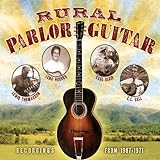
The performances on this cd were recorded 1967-1971 by four musicians who grew up in the early part of the century. The songs are, by our standards, sedate. They display, however, impeccable musicianship and an unmatched musical pedigree. The history of the American popular guitar begins here.Rural Parlor Guitar: Recording From 1967-71 Overview
Want to learn more information about Rural Parlor Guitar: Recording From 1967-71?
>> Click Here to See All Customer Reviews & Ratings Now

0 comments:
Post a Comment