Average Reviews:

(More customer reviews)Are you looking to buy The Slide Guitar: Bottles, Knives & Steel? Here is the right place to find the great deals. we can offer discounts of up to 90% on The Slide Guitar: Bottles, Knives & Steel. Check out the link below:
>> Click Here to See Compare Prices and Get the Best Offers
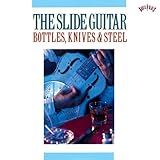
The Slide Guitar: Bottles, Knives & Steel ReviewEternal thanks to Thomas Edison for inventing recording when he did because, had it been delayed for many more years, much of what you hear in this magnificent 1990 release from Sony/Columbia, which presents artists ranging from legends to the virtually unknown, may well have been just a dim memory.Those that fall into the legend category are immediately recognizable, led by the master of the 12-string guitar (he could also play the accordion and concertina, violin, piano, mandolin, and harp or harmonica) Huddie William Ledbetter, better known as Lead Belly (or Leadbelly as he is sometimes listed). Born in January 1888, he left behind an extensive catalogue of Folk standards when he died on December 6, 1949, including this previously-lost version of Packin' Trunk Blues. Another in that vein is Robert Leroy Johnson, born May 8, 1911, a Delta Blues master whose singing, guitar, and song-writing skills influenced so many later arrivals (among them Muddy Waters, Bob Dylan, Jimi Hendrix, Led Zeppelin, The Rolling Stones, Jeff Beck, Jack White, and Eric Clapton) that, in its first year of existence in 1986, the Rock & Roll Hall Of Fame inducted him in the Early Influence Category (Lead Belly was also so honoured in 1988). Indeed, often called the Grandfather Of Rock `N' Roll, Clapton flat-out called him "the most important blues musician who ever lived" (and he didn't live long, passing away at age 27 on August 16, 1938). One listen to Traveling Riverside Blues and you'll hear why he so highly-regarded.
Also in the legend grouping are Tampa Red (You Can't Get That Stuff No More), Bukka White (Bukka's Jitterbug Swing and Special Stream Line), and Son House (Pearline). Hudson Woodbridge, born on January 8, 1904 in Smithville, Georgia, but known from his earliest days as Hudson Whittaker, developed a signature single-string bottleneck approach which, combined with his composing under the name Tampa Red, also had a profound effect on the great Muddy Waters as well as Elmo(re) James, Big Bill Broonzy and Mose Allison. His career lasted much longer as he passed away at age 77 on March 19, 1981. Another who lived to a ripe old age was Eddie James "Son" House, Jr. (born on March 21, 1902 and died October 19, 1988) whose strong, repetitive rhythms also influenced many big names that followed, while Bukka White (born Booker T. Washington White on November 12, 1909) passed away at the relatively young age of 68 on February 26, 1977. A Delta Blues guitarist and singer (and cousin of B.B. King), his unusual nickname Bukka resulted from an erroneous spelling of his first name by the Vocalion label back in 1937.
At the other end of the spectrum are Barbecue Bob and Sister O.M. Terrell, about whom very little is known. Born Robert Hicks on September 11, 1902, Barbecue Bob took his performing name from his main occupation as a cook and, indeed, one of the few photographs of him around show him decked out in his cook's garb. The untitled cut presented here, recorded in 1929 (two years before his death on October 21, 1931) sounds very much like Handy's St. Louis Blues - but with different lyrics. As for Sister Ola Mae Terrell, it appears she was a wandering Holy Ghost Preacher who somehow managed six cuts for Columbia in or around 1953 and then disappeared.
In between these two extremes are some of the best slide guitar artists ever recorded, including Oscar "Buddy" Woods, aka The Lone Wolf, who not only was one of the driving forces behind the development of the lap steel bottleneck blues slide guitar; but is credited by many historians as THE one who created the genre.
These and other details are contained in the six pages of liner notes written by musicologist and author Richard Spottswood (Ethnic Music on Records: A Discography of Ethnic Recordings Produced in the United States, 1893-1942), the AAD sound reproduction is excellent, and with the insert you get a discography of the contents.The Slide Guitar: Bottles, Knives & Steel Overview
Want to learn more information about The Slide Guitar: Bottles, Knives & Steel?
>> Click Here to See All Customer Reviews & Ratings Now

0 comments:
Post a Comment